

Error-Prone Abbreviations: Why This Risk Persists in Modern Medication Workflows

Over the past two decades, electronic health records (EHRs), electronic medication administration records (eMARs), and electronic prescribing have transformed medication management, reducing reliance on handwritten orders, improving legibility, and introducing safeguards such as standardized order sets and clinical decision support.
While these technologies have reduced many sources of error, risks remain embedded in medication management workflows, particularly in how medication information is written, communicated, and transcribed. Often driven by convenience and time savings, error-prone abbreviations, symbols, and shorthand continue to appear in drug names, doses, and administration instructions, contributing to preventable medication errors.
The Enduring Risk of Abbreviations in Medication Communication
The Institute for Safe Medication Practices (ISMP) has long maintained a list of abbreviations, symbols, and dose designations that should not be used when communicating medication information. These are not theoretical risks. Each item on the list has been associated with actual medication errors reported through ISMP’s National Medication Errors Reporting Program.
ISMP advises that these error-prone abbreviations should not be used in any medication-related communication, including:
-
- Internal communications
- Verbal, handwritten, or electronic prescriptions
- Handwritten or computer-generated medication labels
- Drug storage labels
- Medication administration records (MARs)
- Pharmacy and prescriber computer order entry systems
- Automated dispensing cabinets
- Other medication-related technologies
Examples commonly encountered in long-term care (LTC) settings include abbreviations such as “cc” for cubic centimeters, “U” for units, “IU” for international units, “QD” for daily, and “SSI” for sliding scale insulin. Dose formatting issues, such as trailing zeros (1.0 mg) or naked decimals (.5 mg), continue to cause ten-fold dosing errors when misread or misentered.
Even in electronic systems, these abbreviations often persist because some fields, such as the SIG (directions for use), remain free text. Prescribers and other clinicians may also default to habits formed in paper-based workflows, and downstream systems may replicate the text exactly as entered.
ISMP is clear on this point: these abbreviations are not recommended for use in any form of medical communication, regardless of whether information is handwritten, verbal, transcribed, or entered electronically. Their full list remains the national gold standard for what to avoid.
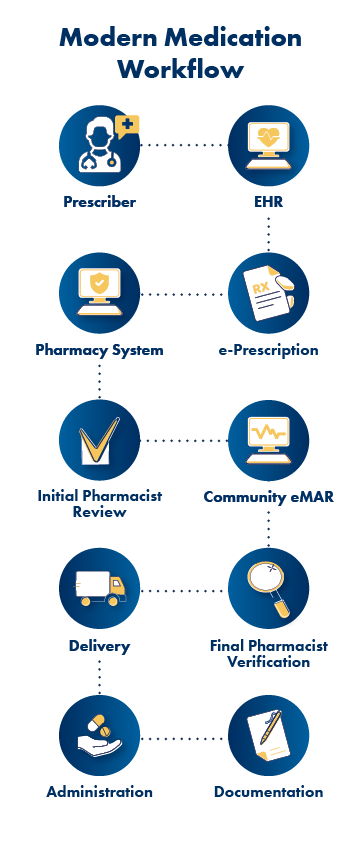
Why Technology Has Not Eliminated This Problem
EHRs and eMARs are effective at reducing medication errors when information is entered in a structured, consistent way. Medication names, strengths, and dosage forms selected from standardized drop-down fields, for example, are generally less prone to misinterpretation than handwritten or verbal orders.
Technology alone does not remove risk at the points where medication information is entered, transcribed, or re-entered by people. Because digital systems rely on human input and configuration, abbreviations, symbols, and shorthand may still be introduced when orders are written by hand, communicated verbally, or entered into an electronic system.
In some cases, this can result in discrepancies between how a medication is documented in the chart, how it appears in the eMAR, and how it is displayed on the pharmacy label. When those sources of truth do not align, ambiguity increases, particularly in environments where multiple caregivers administer medications across shifts and residents have complex regimens.
In senior living and long-term care settings, these gaps matter. Ambiguity doesn’t just impact efficiency; it introduces risk at the point of administration, where clarity and consistency are critical to resident safety.
Abbreviations Still Lead to Real-World Harm
ISMP’s list includes examples that have led to serious outcomes, including overdoses, missed doses, and incorrect routes of administration. For example:
-
- “U” mistaken for a zero, resulting in ten-fold insulin overdoses
- “QD” misread as “QID,” leading to four times daily dosing
- “OD” interpreted as “right eye” instead of “once daily,” resulting in oral liquids placed in the eye
These errors are not mitigated simply because orders are electronic. If anything, automation can amplify them when flawed information is propagated.
What Safer Medication Communication Looks Like Today
Collaboratively, multidisciplinary teams can reduce risk by leveraging existing technology to support safer, more consistent communication throughout medication management workflows. This includes drawing on the clinical expertise of pharmacists to help develop, review, and reinforce standardized practices, along with reinforcing shared education and expectations among the health care team. Examples of best practices to adopt include:
-
- Eliminating error-prone abbreviations and symbols from order sets, forms, and electronic tools (default text, macros, drop-down menus)
- Using plain language when documenting medication directions, such as “daily,” “at bedtime,” or “every other day”
- Formatting doses with appropriate spacing, leading zeros, and commas
Organizations that treat clarity and consistency in medication communication as a shared responsibility across disciplines are better positioned to prevent errors before they reach the resident.
A Reminder Worth Repeating
Medication safety risks change as technology evolves, but some hazards persist precisely because they feel familiar. Error-prone abbreviations are one of them.
ISMP’s list remains as relevant today as it was when first published, not because systems have failed, but because human habits carry forward. Recognizing where technology helps and where it does not is essential to continuing progress in medication safety.
Why the Right Pharmacy Partner Matters
Addressing these risks requires more than awareness alone. Partnering with a pharmacy that proactively supports safer medication management practices is an important part of this effort. Pharmacists play a critical role on the multidisciplinary team by helping to identify error-prone habits, establish standardized documentation expectations, and reinforce shared accountability for how medication information is communicated across workflows.
At Guardian, this approach is supported by layered safeguards and clinical oversight. Our pharmacists apply a two-step verification process to every order, beginning with an initial clinical review (PV1) when the order is received and followed by a final verification (PV2) prior to dispensing. These safety checks are designed to identify potential issues early, including ambiguous directions and unusual dosing. Through Guardian’s Clinical Intervention program, our pharmacists documented more than 100,000 clinical interventions last year alone—including more than 25,000 related to order clarifications and nearly 9,000 involving unusual dosing. Together, these efforts reflect the essential role pharmacists play in ensuring safe and appropriate medical care for residents.
For a complete list of abbreviations, symbols, and dose designations that should not be used, review ISMP’s List of Error-Prone Abbreviations, Symbols, and Dose Designations.
Source: Institute for Safe Medication Practices (ISMP). ISMP List of Error-Prone Abbreviations, Symbols, and Dose Designations. ISMP; 2024. Available at: https://home.ecri.org/blogs/ismp-resources/list-of-error-prone-abbreviations